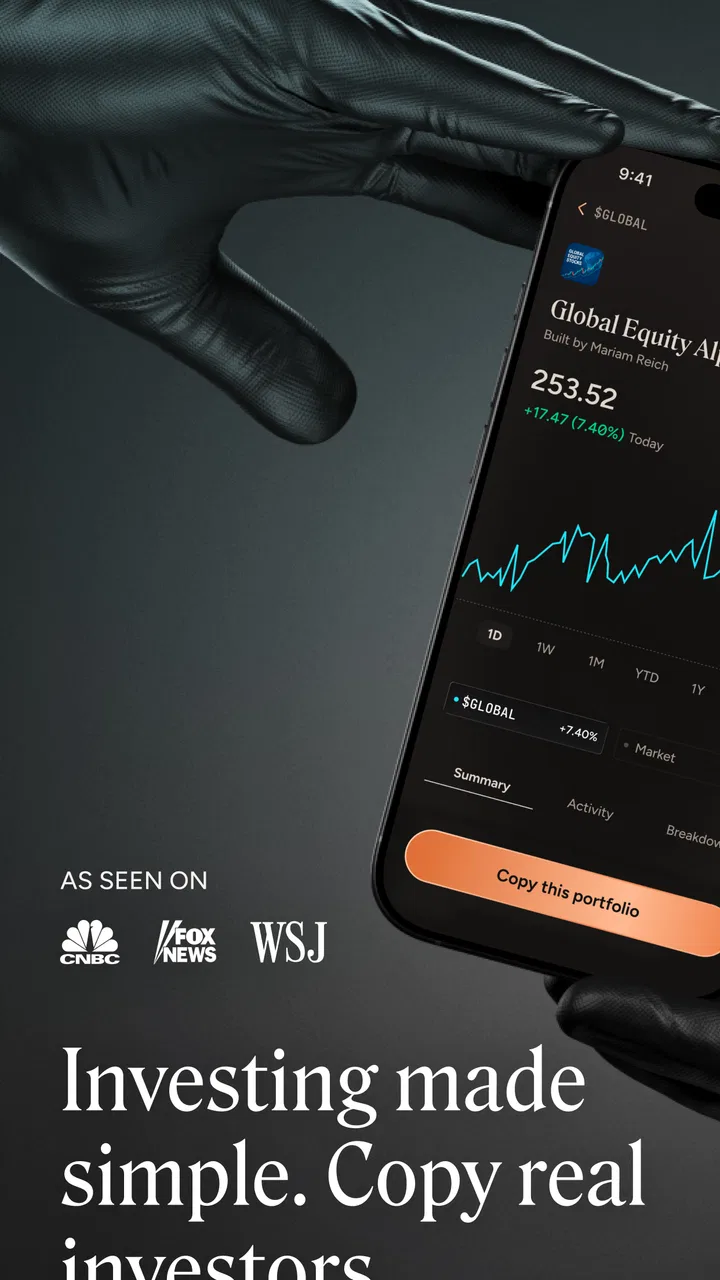
dub: Social Investing Unlocked
- 4.5
- Rating
- 100.00K
- Installs
- Free
- Price

 Analysis by App-foxy
I approached dub: Social Investing Unlocked as a finance app for people who want to follow investment ideas through a more social lens. Its focus is not simply on entering trades or watching a conventional market dashboard. Instead, it brings attention to people and portfolios, including Pelosi stocks, hedge funds, and creator portfolios. That makes the experience feel closer to exploring investment trends than managing a traditional brokerage account.
My first impression was that dub is most useful as a discovery and tracking tool. I can imagine opening it during a commute, checking what a creator portfolio is doing, and saving a few ideas to investigate later. I would not treat that quick glance as enough reason to buy anything, but it can make the research stage more approachable for someone who finds standard financial screens intimidating.
The app is free to install, rated for Everyone, and developed by dub Support Team. Its current release is version 5.61.0, and it runs on Android 8.0 or later. The public response is encouraging, with a 4.5 average from around 1.5 thousand ratings and more than 100 thousand installs. Those figures suggest a real user base, while the relatively focused concept explains why it may appeal more to curious investors than to people seeking a complete banking replacement.
You May Also Like

 Blood Strike: 2.5 Anniversary
Blood Strike’s Loadouts Turn Every Drop Into a Tactical Gamble
A close look at Blood Strike’s custom loadouts: how fast access to signature weapons reshapes its battle royale rhythm, rewards preparation, and narrows the gap between fights.

 Pandora - Music & Podcasts
Pandora’s Music Is Easy to Start, but Harder to Recover
Pandora’s strength is its low-effort path from a seed to a station. Its weak spot is how much confidence it asks you to place in connection, setup, and quiet recovery.

 8 Ball Pool
 Is Built on Rivalries, Rematches, and Routine
A close look at the rivalries, rematches, shared routines, and unanswered safety questions that turn a quick pool match into a persistent mobile community.

 Samsung Music
’s Quiet Strength Is Playing What You Already Own
Its reach comes less from spectacle than from dependable access to a personal library. That simplicity is both the app’s strongest retention engine and its ceiling.

 AccuWeather: Weather Radar
AccuWeather Review: A Quick, Clear Forecast for Everyday Decisions
For everyday plans, the best forecast is the one you can understand quickly. AccuWeather makes rain timing, radar, and local conditions easy to act on, with a few trade-offs.

 Hill Climb Racing
Why Hill Climb Racing Still Turns Crashes Into One More Run
A tiny car, a bumpy hill and one more upgrade: Hill Climb Racing keeps resurfacing because its simple chaos makes every near-miss feel personal.
More From Our News Desk



How the interface supports clearer reading and navigation
The biggest accessibility question for a finance app is whether it helps me understand information without forcing me to decode a wall of market terminology. dub has a naturally more approachable subject structure because it organizes attention around identifiable investors, funds, and creators. Following a person or portfolio gives me a starting point that feels easier to grasp than scanning a long list of symbols with no context.
That structure can help readers who process information better when it is grouped around a clear subject. Instead of beginning with an empty research screen, I can start with a portfolio theme and then decide which holdings deserve closer attention. For a beginner, that sequence may reduce the initial cognitive load. For a more experienced investor, it can work as a shortcut for comparing ideas without replacing deeper research elsewhere.
I also like the distinction between observing an idea and acting on it. Social investing can create pressure to move quickly, so I find it important to use the app as a place to notice patterns first. A practical routine would be to review a creator portfolio, write down why a holding caught my attention, and only then verify the company through primary financial information. That small pause turns a potentially impulsive feed into a research queue.
There is a trade-off here. A social presentation can make complex decisions feel easier than they really are. A recognizable portfolio or popular investor may attract attention before I have considered risk, time horizon, diversification, or whether the information is still relevant. The app is therefore clearer as a discovery layer than as a complete explanation of every investment decision.
For people with reading or attention difficulties, short visits may be more manageable than long research sessions. I can use one narrow question at a time: which portfolios interest me, what companies appear repeatedly, or which idea needs verification? That approach avoids trying to understand everything in one sitting. It also makes the app more useful for users who prefer small, repeatable tasks rather than a dense financial planning workflow.
What the social model makes easier
The app’s emphasis on people and ideas gives me a conversational way to begin investing research. Someone who is comfortable following a creator but uncomfortable with financial jargon may find that bridge helpful. The concept can also support shared discussions with friends: rather than saying only that a stock looks interesting, I can explain that I noticed it through a particular portfolio theme and then discuss the reasons independently.
That does not mean the social layer is automatically reliable. I would still check whether a portfolio reflects a long-term strategy, a short-term opinion, or simply a snapshot. The useful insight is that dub can help me decide what to research, but it should not be the only place where I decide what is true.
Motor and sensory considerations during everyday use
Finance apps can be difficult for users who rely on precise tapping, stable visual focus, or a quiet environment. In my view, dub’s strongest situational advantage is that its concept can be used in short bursts. I do not need to turn every visit into a full financial review. A quick check of a portfolio idea may be more realistic for someone managing fatigue, limited concentration, or an unpredictable schedule.
That short-session style is useful, but it also creates a responsibility to slow down before making decisions. A crowded commute, bright outdoor light, or noisy room is a poor setting for judging an investment. I would browse in those conditions only to collect ideas, never to make a final decision. Separating casual viewing from serious evaluation is one of the safest ways to use a social finance app.
Users who have difficulty with small text, dense charts, rapid visual changes, or color-based distinctions should judge the interface against their own needs before relying on it regularly. I would not assume that a finance-focused design automatically works well with every assistive setup. If reading a screen requires too much effort, the app may be better used alongside a larger display, device-level text adjustments, or another source that presents the same information more comfortably.
Motor accessibility also matters when an app encourages exploration across many profiles and holdings. Repeated tapping, scrolling, or switching views can become tiring, especially when I am trying to compare several ideas. My practical workaround would be to limit each session to one portfolio or one research question. That reduces unnecessary navigation and makes it easier to remember what I have already checked.
For users with sensory sensitivities, the social-investing format may be easier than a constant stream of breaking financial alerts, but the emotional tone can still matter. Seeing other people’s investment choices may create urgency or fear of missing out. I would treat the app as a calm reference point only if I can browse without feeling pushed into immediate action. If the social element increases stress, a quieter, conventional market tracker may be a better fit.
Using dub across different situations
A realistic everyday scenario would be a beginner who has twenty minutes on a weekend to learn about investing. I would open dub, explore a creator portfolio that matches my interests, note a few recurring companies, and close the app before making any decision. Later, I would compare those companies with independent sources and consider whether they fit my goals. In that workflow, the app saves me from starting with a blank page while keeping the important judgment outside the social feed.
Another scenario is an experienced investor who wants a quick way to watch themes without rebuilding a watchlist manually. Following hedge fund activity or creator portfolios could provide prompts for further analysis. The benefit is not that the app replaces a professional terminal; it is that it can surface a different angle on what deserves attention.
It may also suit someone who learns best by observing examples. Seeing how a portfolio is assembled can make abstract ideas such as concentration or thematic exposure easier to discuss. Still, I would explain the difference between seeing a holding and understanding its role. A company appearing in a portfolio does not tell me by itself whether it is a core position, a speculative bet, or a temporary choice.
People who need hands-on trading, detailed budgeting, tax tools, bank connections, or comprehensive retirement planning should look elsewhere or use dub alongside a more complete financial service. Its appeal is narrower and more focused. I would not choose it as my only finance app if I needed a full record of personal accounts or a detailed household money plan.
The same applies to users who want purely objective research. The social angle is the point, but it is also the source of potential bias. A conventional market research platform may be preferable when I want fundamentals, filings, analyst tools, or a deliberately less personality-driven experience. dub is better when I want human-curated starting points and a way to observe investment ideas through portfolios.
Where the experience still has barriers
The first barrier is interpretation. A portfolio can look simple on screen while hiding important questions about timing, risk, and context. Users who are new to investing may assume that copying an idea is equivalent to understanding it. I would strongly recommend treating every visible holding as a prompt, not a recommendation tailored to my circumstances.
The second barrier is emotional design. Social investing can make comparison feel personal. If I see an appealing portfolio performing well, I may be tempted to chase it; if I see a disappointing position, I may react without understanding the wider strategy. A good personal rule is to record the reason for considering an investment before looking at how exciting or popular the surrounding discussion feels.
There is also a financial boundary to keep in mind. Although the app itself is free, it includes optional in-app purchases ranging from $9.99 to $89.99 per item. That means I would review any purchase screen carefully and decide whether the extra value matches my needs. Someone who only wants occasional portfolio discovery may not need to spend anything, while a frequent user should understand what paid access changes before committing.
Navigation can become less comfortable when I try to compare too many people, funds, and ideas at once. The social format encourages browsing, but browsing is not the same as building a disciplined investment process. I would keep a separate note with the date I reviewed an idea, the reason it mattered, and the questions still unanswered. That simple external record prevents the app from becoming an endless stream of disconnected impressions.
Another limitation is that accessibility is personal. The Everyone age rating makes the app broadly approachable in terms of audience, but it does not guarantee that every user will find the visual layout, interaction style, or financial language equally comfortable. I would test it with my own device settings and routines rather than assuming that a general audience rating covers individual access needs.
Who should use it, and who should skip it
I would recommend dub to curious beginners who want a friendlier entry into investment research, investors who enjoy studying portfolio themes, and users who like learning from visible examples. It can also help experienced investors collect ideas quickly before doing more serious analysis. The strongest fit is someone who understands that social information is a starting point rather than a personal financial plan.
I would be more cautious recommending it to anyone who is likely to copy trades impulsively, feels anxious when comparing results, or needs detailed personal finance administration in one place. It is also not my first choice for a user whose main requirement is advanced research depth. In those cases, a brokerage platform, budgeting tool, or traditional market-analysis service may be more suitable.
For accessibility-conscious users, I see the app as potentially useful when short, focused sessions and portfolio-based organization match their way of processing information. I would pair it with device accessibility settings and an independent research source if text, charts, tapping, or social pressure becomes difficult. The right question is not whether the app is universally accessible, but whether its specific presentation works for the person using it.
My inclusive verdict
After looking at dub as both a finance tool and a social experience, I see a thoughtful entry point for investment discovery rather than a complete financial command center. Its focus on Pelosi stocks, hedge funds, and creator portfolios gives it a distinct identity, and the free starting point lowers the barrier to trying it. The developer, dub Support Team, has built around a concept that can make market exploration feel less isolated and less intimidating.
My recommendation comes with a clear condition: use the app to find questions, not to skip them. I would browse a portfolio, pause, verify the underlying information, and consider my own goals before acting. That workflow makes room for users with different levels of knowledge and different access needs, because it does not demand that every decision happen during one fast session.
With over 100 thousand installs and a strong 4.5 average, it has enough traction to be worth testing, but popularity should not decide whether it belongs in my routine. I would try the free experience first, check whether the reading and navigation style suits me, and only consider an in-app purchase if I clearly understand its value. For me, the best use of dub is as an accessible idea-finding companion, not a substitute for careful investing research.
FAQs for dub: Social Investing Unlocked
01What is dub: Social Investing Unlocked?
dub is a social investing app designed to make portfolio discovery and investing more accessible. It allows users to explore investment strategies, follow portfolios associated with creators or experienced investors, and learn from their decisions. The app combines social content with investing tools, so it may appeal to beginners who want ideas and context before making their own investment choices.
02How does investing through dub work?
After creating an account and completing the required setup, users can browse available portfolios or investment strategies and decide which ones they want to follow. Depending on the current features and eligibility requirements, selected portfolio changes may be reflected in the user’s own account. It is important to review each strategy carefully, understand the risks, and confirm every investment action before proceeding.
03Is dub suitable for beginner investors?
dub can be useful for beginners because it presents investment ideas in a more social and approachable format than many traditional brokerage platforms. However, the app should not be treated as a guarantee of success or as personalized financial advice. New investors should learn basic concepts, diversify appropriately, check fees, and avoid copying a portfolio without understanding its goals, risks, and potential losses.
04Does dub charge fees or require a minimum investment?
The costs and minimum investment requirements may depend on the account type, available portfolio features, and the terms shown during registration or before placing an order. Users should carefully read the current pricing information, disclosures, and any trading-related charges in the app. Since financial products and platform policies can change, always verify the latest details before depositing money.
05Is my money safe when using dub?
dub is an investing platform, so account protections and safeguards depend on the brokerage or financial partners supporting the service, as well as the user’s location and account status. Market investments can lose value, and no app can eliminate investment risk. Before downloading or funding an account, review the platform’s regulatory information, privacy policy, security practices, and applicable investor-protection disclosures.
Pros
- Easy-to-follow insights for users new to investing
- Social features make market discussions more engaging
- Helps users discover different investing perspectives
- Useful watchlists for tracking selected assets
- Clean interface keeps key information easy to find
Cons
- Investment ideas may encourage impulsive decisions
- Community opinions can be biased or overly optimistic
- Advanced research and charting tools may feel limited
- Some features may require an account or subscription
- Market information may not always be real-time

dub: Social Investing Unlocked
Gallery